How Much Should SEO Cost for a Small UK Business? (2026 Pricing Guide)

Ask five providers how much SEO costs and you will get five different answers, ranging from £99 a month to £5,000. That spread is not a scam, but it is not entirely honest either. This SEO pricing guide breaks down what SEO costs in the UK in 2026, what you get at each price point, and how to work out whether the number in front of you makes commercial sense.
The short answer: how much does SEO cost in the UK?
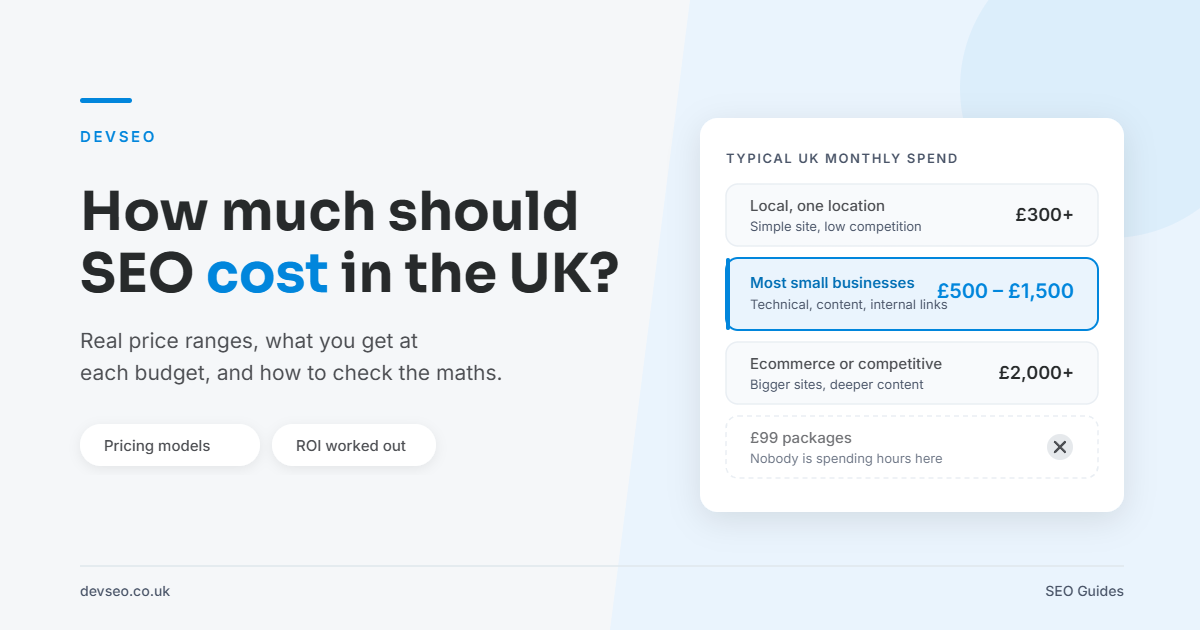
For a small business in the UK, a realistic monthly SEO investment sits between £500 and £2,000 per month. Below £500 you are usually buying a template. Above £2,000 you are paying for a level of competition most local businesses do not face.
Commonly quoted UK SEO pricing looks like this:
| What you are buying | Typical SEO price |
|---|---|
| Freelancer or SEO consultant, hourly | £40 to £120 per hour |
| One-off technical SEO audit | £300 to £2,500 |
| Local SEO, single location | £300 to £1,000 per month |
| Small business monthly retainer | £500 to £2,000 per month |
| Mid-market or ecommerce retainer | £2,000 to £5,000 per month |
| National or enterprise SEO campaign | £5,000 to £20,000+ per month |
| One-off project, for example a migration | £1,500 to £10,000 |
Treat the average cost of SEO as orientation, not gospel. What matters far more than the number is what sits underneath it, which is what the rest of this cost guide covers.
Why SEO pricing in the UK varies so wildly
SEO is not a product with a fixed unit cost. It is skilled time applied to your specific situation, so the price moves with how much time your situation needs. Six things drive the cost of SEO services:
- Competition. Ranking a plumber in Falkirk and ranking an insurance comparison site are not the same job. Competitive corners of the UK market need more content, more authority, and more months of SEO work.
- The state of your website. A fast, clean, well structured site needs far less remedial work than a ten year old build with duplicate pages and no indexing hygiene. Technical debt is billable.
- Scale. Ten service pages is a different job to four thousand product URLs.
- Local versus national. Local SEO for one town is cheaper than competing nationally. Multi location businesses pay roughly per location.
- Content volume. Content is usually the largest single line in any SEO budget. Four properly researched articles a month costs real money.
- Who does the work. A senior SEO professional with ten years behind them costs more per hour than a junior following a checklist, and is usually cheaper per result.
The four SEO pricing models explained
Monthly retainer
The most common pricing structure. You pay a fixed fee for an agreed scope of ongoing SEO each month. Monthly SEO retainers suit the work because it is cumulative: technical fixes, content, internal linking and authority all compound.
Watch for: vague scopes. “Ongoing optimisation” is not a deliverable.
Hourly or day rate
Typical UK rates run £40 to £120 per hour for freelancers, and £90 to £200 for a senior SEO specialist. This pricing model works for advisory work, training your in-house team, or a fixed number of hours on a site you mostly manage yourself.
Watch for: paying for hours when you cannot judge what the hours produced.
Project-based pricing
A defined piece of work for a defined price: a technical SEO audit, a migration, a content structure overhaul. This is the lowest risk way to start with a new SEO provider, because both sides know where it ends.
Watch for: an audit that hands you a 60 page PDF and no implementation.
Performance-based SEO
Payment tied to rankings, traffic or leads. Superficially attractive, occasionally sensible. In practice it pushes providers toward quick wins and easy keywords, because that is what triggers payment.
Watch for: “guaranteed page one” offers. Nobody controls Google, so any guarantee is either meaningless or attached to keywords nobody searches.
The different types of SEO providers in the UK
The three types of SEO provider carry different price tags and different risks.
| Provider | Typical cost | Best for | Main risk |
|---|---|---|---|
| Freelancer | £400 to £1,500 per month | Small businesses, local SEO, one clear goal | Single point of failure, limited capacity |
| SEO agencies | £1,000 to £5,000+ per month | Bigger sites, ecommerce, multi channel | Junior staff doing work sold to you by a senior |
| In-house SEO | £35,000 to £55,000 salary plus tools | Businesses where search is the primary channel | Slow to hire, one person cannot cover everything |
In-house SEO looks expensive until you notice it is often cheaper than a mid-tier agency retainer across 12 months. It only works if there is enough continuous work to justify a salary, and if you can support that person with content and development resource. For most small businesses in the UK, a good freelancer or a small agency is better value.
SEO costs by business size and sector
| Business size or type | Monthly SEO investment |
|---|---|
| Sole trader or single location local business | £300 to £800 |
| Small business, 5 to 20 staff | £750 to £2,000 |
| Multi location or regional | £1,500 to £4,000 |
| Ecommerce with a large catalogue | £2,000 to £6,000 |
| B2B SEO with long sales cycles | £1,500 to £5,000 |
| National brand | £5,000+ |
Sector matters as much as business size. Legal, finance, insurance and SaaS are the most expensive markets in the UK because every competitor is already investing heavily. Trades, hospitality and niche B2B are considerably cheaper, because good SEO is still rare in those spaces.
What you actually get at each budget level
Under £500 per month
Realistically, a few hours of work: basic on-page tweaks, a monthly report, some directory listings. This can move the needle for a very small local business with a simple site and low competition. It will not win anything contested.
£500 to £1,500 per month
The sweet spot for most small businesses. At this level a competent provider can run technical SEO fixes, produce one to three properly researched pieces of content a month, improve internal linking, manage local SEO, and do genuine keyword research tied to your business goals.
£1,500 to £3,000 per month
Serious ground. Deeper content programmes, digital PR or link acquisition, conversion work alongside rankings, and enough hours for a larger or more complex site. Appropriate for competitive markets or ecommerce.
£3,000 and above
A comprehensive SEO campaign with specialists across technical, content and authority. Worth it only when the revenue at stake justifies it, which for most local businesses it does not.
What should be included in an SEO package?
Whatever the price, a decent SEO package should cover these aspects of SEO:
- Technical SEO. Crawling, indexing, canonicals, site speed, structured data, and fixing what blocks Google.
- Keyword research. Tied to commercial intent and your business needs, not just search volume.
- On-page work. Titles, headings, internal linking, and page structure that matches what people are actually searching for.
- Content. New pages and improvements to existing ones, written for the searcher rather than the algorithm.
- Local SEO where relevant. Google Business Profile, citations, location pages, reviews.
- Authority building. Earned links and mentions, with a clear explanation of where each one comes from.
- Reporting. Tied to leads and revenue, not a screenshot of ranking positions.
If a proposal is missing technical SEO entirely, it is a content package with an SEO label on it. That may still be what you need, but you should know which one you are buying.
Why cheap SEO usually costs more in the end
The £99 a month SEO package is the most expensive thing in this article. Behind that price sits automated audits nobody reads, spun content, and links bought from private blog networks. The first two waste money. The third can actively harm you.
The real cost of cheap SEO is rarely the fee. It is the 12 months you did not spend doing something that worked, plus, occasionally, a cleanup project to undo the damage. Cleaning a toxic link profile or a site full of thin AI content costs more than doing it properly would have.
A simple test: if the price is low enough that nobody could be spending meaningful hours on your account, nobody is.
Is SEO worth the investment? Do the maths first
Do not ask whether SEO is worth it in the abstract. Work out what it needs to produce to pay for itself. Four numbers give you your SEO return on investment:
- Your monthly SEO spend.
- Your average order or contract value.
- Your gross margin.
- Your website conversion rate.
Worked example. You invest £1,000 per month. Average order value is £400 and gross margin is 40%, so each sale contributes £160. To break even you need seven extra sales a month. If your site converts at 2%, that is roughly 350 extra relevant visits a month.
Now ask whether 350 extra monthly visits is plausible for your keywords. For a local service business with a handful of decent terms, often yes. For a brand new site in a saturated national market, probably not within six months. That single calculation tells you more than any SEO pricing guide, including this one. Our post on marketing metrics that matter goes further on which numbers are worth tracking.
How long before SEO pays back?
Expect three to six months before meaningful movement, and nine to 12 months before a campaign can be fairly judged. Technical fixes can show up within weeks, because Google simply needs to recrawl. Content and authority take longer, because they depend on Google building confidence in your site.
SEO is a long-term strategy, and that is the honest reason it does not suit every business. If you need leads next Tuesday, buy ads. If you want a channel that keeps producing after you stop paying, SEO compounds in a way paid search never does.
SEO versus PPC on cost
They are different purchases. PPC buys traffic and stops the moment the card declines. SEO buys an asset that keeps working, slowly, with no guarantees.
For most small businesses the answer is not either or. Run paid search to prove which keywords convert, then invest SEO budget in ranking for the ones that do. That sequencing prevents the most common waste in small business search marketing, which is ranking beautifully for terms that never produce a sale.
How to budget for SEO across 12 months
Treat it as a 12 month line, not a monthly gamble. A sensible pattern for a UK business looking to start:
- Months 1 to 2. Weight the budget toward a technical SEO audit and implementation. Fixing foundations first makes everything after it cheaper.
- Months 3 to 8. Shift to content and internal linking. This is where most of the compounding happens.
- Months 9 to 12. Authority, conversion improvements, and doubling down on whatever is already working.
Set your monthly SEO investment at a level you can sustain for a year. £1,000 a month for 12 months beats £2,500 for four months and then nothing, every time.
What to ask before you sign anything
Five questions that separate good SEO from expensive SEO:
- What exactly is included in the quoted price? Deliverables and rough hours, not buzzwords.
- Who does the work? The person in the pitch is not always the person on the account.
- Can you show results in business metrics? Positions are a means. Leads and revenue are the point.
- What is the contract length and notice period? A 12 month lock-in with 90 day notice is a red flag on a first engagement.
- Who owns the assets? Content, accounts and data should remain yours when the relationship ends.
Walk away from guaranteed rankings, secret proprietary methods, no access to your own Search Console, and any refusal to say where links come from.
What DEVSEO charges, and why
Since this is about transparency, here is our own number. DEVSEO engagements start from £1,000, whether that is a one-off technical audit with the fixes implemented, or ongoing monthly SEO covering technical maintenance, content structure, internal linking and performance monitoring.
We start there for the reason set out above: below roughly £1,000 there are not enough senior hours in a month to change anything on a site that matters, and we would rather say so than sell you a smaller number and a monthly report. Where a project needs a £3,000 a month campaign, we will tell you that too.
If you are not ready to commit to a figure, request a free mini audit first, or run your own checks with our free SEO tools. Both will tell you whether the problem is technical, competitive, or something a budget will not fix.
Frequently asked questions
How much should a small business spend on SEO per month?
For most UK small businesses, £500 to £1,500 per month buys enough hours to make real progress. Below that, be realistic about scope.
Is £500 per month enough for SEO?
For a local business with one location, a reasonable site and modest competition, yes. For national ecommerce, no.
How much does an SEO audit cost in the UK?
Between £300 and £2,500 depending on site size and depth. The important question is whether implementation is included.
Can I do SEO myself?
Yes, for the fundamentals. Titles, structure, internal links, page speed and local listings are all learnable. Most owners run out of time rather than ability.
Is SEO a one-time cost or an ongoing investment?
Technical fixes are largely one-off. Content and authority are ongoing, because competitors keep publishing and Google keeps changing.
Does SEO cost more now because of AI search?
Not fundamentally. Being cited in AI answers depends on the same things as ranking: clear structure, credible content, and a site Google can crawl. Be sceptical of anyone charging a separate premium for it.
Can anyone guarantee first page rankings?
No. Anyone who does is either misunderstanding how Google works or hoping you do.
The bottom line on SEO costs
The right SEO budget is the smallest one that buys enough senior time to make progress on your specific site, in your specific market. For most small businesses in the UK that lands between £500 and £1,500 per month, or a one-off project if the main problem is technical rather than competitive.
Work out your break-even number before you take a single call. It turns a vague question about price into a straightforward commercial decision, and it makes the sales conversation considerably shorter.